.NET Signals an Industry Shift
Wed, Sep 12, 2001; by David Bau.
What is Microsoft .NET?
It is a mishmosh of offerings,
including a password service, a bunch of new
devices, and a basket of
Java-like programming languages. To some, it
is just Microsoft's latest wave of hype.
But it is not just hype. There is a reason
for it. Microsoft is responding to an dramatic
shift in the industry that is being caused by
a three-way Moore's law crisis.
Let me explain.
The Old Windows Platform Triangle
For the last two decades, Microsoft has been at the center
of an industry built around its universal software
platform. As with all platform businesses,
Microsoft has focused on three lines of attack
that support each other like a triangle: customer-facing
products, company-controlled adapter technology, and a
community of developers. The three-way focus
translates to Microsoft's three complementary product
lines: applications, operating systems, and developer
tools.
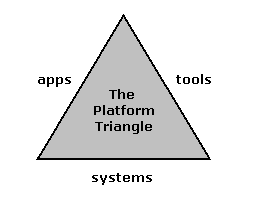 . .
Let's look at each of the three legs of Microsoft's traditional platform triangle.
Microsoft applications have always been driven by the
company's basic little ambition: to put its software in the
hands of every person on the planet. Bill Gates' original
vision of "a computer on every desk and in every home"
may be uninspiring today, but in 1972 it was a radical
goal that took several decades to play out. Remember that
before the microcomputer revolution, computers were
just for specialists who did
esoteric data analysis. Microsoft produced
applications that changed the
landscape by broadening the appeal of computers to the
masses. And they have succeded. By solving everyday
problems, Microsoft Word and Excel have today
displaced the pen and calculator as the
ordinary person's desktop weapons of choice.
However, the genius of Microsoft's platform strategy
has never been in their applications alone, but
in the fact that they build all their applications on
top of Microsoft's proprietary adapter
technology: Windows.
Other operating systems may rate higher in elegance,
power, or maintainability. But Microsoft's Windows
operating systems are
unparalleled software adapters, supporting
thousands of different applications running on
thousands of different kinds of hardware configurations.
And Microsoft continuously evolves Windows to support
both the latest devices and the oldest software.
The reason extreme operating system adaptability has
been such a wonderful design is that it allows people to
tap most powerful invention of the information age:
Moore's law. In 1965 Intel founder Gordon Moore observed
and predicted that due to the rapid
pace of innovation in semiconductors,
computer
systems would double their speed every 18 months.
Moore's daring prediction of exponential progress
has been remarkably on-target. But the cause and effect of
the accelerating rise of computer power has been
a never-ending tornado of changing hardware designs,
not just in semiconductor manufacturing, but
at every level in storage, communications, interfaces,
peripherals, and software. Every month there are new hardware
protocols, formats, chipsets, devices, and software
applications enabling faster communications, bigger storage,
cheaper designs, and clever new functionality.
If you have a software solution that
is designed to work with a specific configuration of
hardware, the inexorable march
of Moore's law will guarantee that your monolitic
solution will be obsolete - ten times too slow - in
just 60 months.
To avoid being left in the dust of hardware
obsolescense, you need to layer your solution
on top of a very flexible adapter that lets you
upgrade your hardware without throwing
away your software. In other words, to fly in
Moore's tornado, you need Windows. Windows works
because it bridges the gap between yesterday
and today. Windows is always fresh.
But Microsoft can not and does not keep Windows
fresh on its own. For this, they rely on the
the third leg of the platform triangle: Microsoft's
community of independent developers.
This part of the puzzle is less visible
than the other two because the activity is not
aimed at the mass market. But this third leg
is possibly the most important:
its purpose is to nurture and grow the triangle.
Windows is what I like to call an n2 product.
It is an adapter technology that supports interconnections
between n different hardware and software products, and
its value is proportional to n2,
which is the number of interconnections it provides.
As long as "n" continues to grow, Windows will be
continue to become more valuable, and Microsoft will
continue to become more profitable. Therefore
Microsoft has an enormous incentive
to encourage third parties people to build other
products to be compatible with windows to grow "n".
So in order to build their Windows platform, Microsoft has
always spent enormous efforts in supporting
third-party software and hardware vendors who build
solutions that are compatible with Windows. They sell
programming languages, Visual Basic and Visual C++,
specially designed to help developers build software
for Windows. They run a hardware compatibility lab
where they test hardware and drivers for quality.
And every quarter Microsoft releases through
a program called MSDN, a vast amount of supporting
technical software, literature, and support for independent
developers. This encyclopedia is needed because programming
Windows can be complex: it takes a lot of knowledge to
squeeze all the power and performance possible out of a
Windows system. Nevertheless, the effort is
worthwhile: releasing an application on Windows means that
your product can be used by almost every computer user
and on almost every personal compuer hardware configuration.
The "n" for Windows is large, and the "n2"
value is unbeatable.
Microsoft has built a uniquely spectacular
hundred-billion-dollar business around this
the Windows platform. But Microsoft's platform
triangle is about to collapse.
Moore's Triple Crisis
Currently, the software industry, and
Microsoft in particular is facing a triple
crisis on all
three legs of the platform triangle.
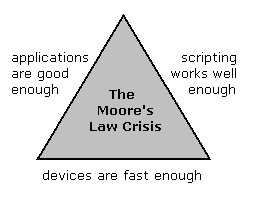
In applications, Microsoft is facing the problem
of saturation. The widely recognied issue here
is that almost everybody who wants to do something with
their computer software can already do it. Why would you
buy a new version of Microsoft Word or Excel? You already
have an old version, and it already spellchecks,
autocompletes, slices, and dices. It is hard to
justify buying a new version of a digital product
that works fine and never wears out. Unfortunately
for Microsoft, desktop software is immortal.
In the next generation of applications, Microsoft
is facing competitors like America Online
that are using a new model for software applications.
Why doesn't AOL suffer from the same saturation
problem that Microsoft is facing? There are two
reasons. First of all, AOL focuses not on software
inside the box, but on software between
boxes. As computers become more numerous and cheaper,
the big world outside the box becomes far more
interesting than the little world inside the box.
The second trick is that
AOL sells software products that are only good as
long as you pay for them. Stop subscribing,
and you don't get AOL's chat rooms, instant
messaging, or email services. Also, to enjoy
Time Warner's latest movie, book, or news,
you need to pay for the content when you get it.
The new generation of software applications
will not suffer from the same business-killing
longevity as Microsoft's desktop software.
The new wave of software applications are
are linked to services, time, community, or
content. The new wave of software has
ephemeral value.
In operating systems, Microsoft is being
confronted by an inversion of Moore's law.
Since about 1998, it has become obvious that the
exponentially rising power of PC technology has started to
overshoot the needs of the ordinary customer. This
means people are starting to shop for cheaper
computers instead of more powerful ones.
If Moore's law says that power doubles every 18 months
at a fixed price point, it also implies that at a
fixed power point, prices see twice as much
downward pressure every 18 months. This
inversion has huge implications: as people start
focusing more on price, the traditional
torrent of new hardware standards is slowing down,
and the new focus is on cutting costs everywhere and
on a new generation of simpler, more monolithic
solutions.
One Microsoft competitor that is taking advantage
of the Moore's law inversion is Palm.
The latest Palm VII is
based on the same old Motorola architecture that
powered the original Palm 1000 five years ago,
which also happens to be based on the same
architecture used by the Apple's original beige
Macintosh in 1984;
Palm is only now planning for its first major change
in architecture ever, with a plan to move from
the Motorola 68000 to the ARM's RISC architecture.
In this and many other ways, the world of Palm devices has
proven to be a quiet backwater that is fairly
isolated from the Moore's law hurricane of
shifting standards. Although Palm's operating system is
extremely simplistic and doesn't deliver the same
amazing adaptability as Microsoft's Windows,
the cheap and focused design has value.
Palm devices are less expensive, smaller, and
have longer battery life when compared to Windows
CE devices, due to Palm's simpler design.
Another competitor riding the Moore's law inversion
is Linux, the unix-like
operating system that is built around freely
available open-source code. The obvious benefits of
Linux are cost and control. Licensing Linux is
costs nothing, which makes it suitable for cheap
hardware devices. And since the source code for
every bit of Linux is open, vendors that want to
twist the operating system to introduce radical
innovations such as new high-performance
filesystems can do so. As a result, Linux is
spawning a new generation of specialized monolithic
appliances such as the Cobalt Qube and the TiVO
video recorder. The fact that Linux doesn't make
it as easy as Windows for the end-user to upgrade
hardware or software inside the computer doesn't
matter: people don't upgrade these specialized,
cheap devices. They replace them.
In the developer community, Microsoft faces
a suprise: a brain drain caused by
dramatically increasing developer
impatience. Microsoft has always made enormous
investments in libraries, compilers, and tools
to help developers be more productive, and nobody
doubts that Microsoft's tools are some of the
best available. So why has the center of gravity
shifted away from Microsoft's tools?
One reason is that Microsoft was slow to
recognize that the Moore's law crisis affects
development costs just as dramatically as
it affects hardware costs. As computing
power gets cheaper and software becomes
more ephemeral, it makes sense to save
software development hours by wasting
CPU cycles. This means that some convenient
approaches to programming that used to be
too wasteful of computing power have now
become cost-effective.
Java is emblematic of the development
community shift. Sun's Java system uses the
system's computing power to provide software designers
with programming conveniences such as automatic
memory cleanup, error checking, and self-describing
code. Similar systems like Smalltalk and Lisp have
been tried before. But they failed because compuer
power was scarce and software was immortal, so
it was a mistake to waste CPU cycles for the
convenience of programmers. However, in the
new era where there is a Moore's law surplus of
computing power and software is ephemeral, you must
be willing to waste CPU power in order to save time
on software development. This is what Java is about.
Microsoft's Windows-oriented development tools
are focused on optimizing CPU performance. But
in today's world, it is completely pointless
to have programmer spend weeks counting up
memory resources when our computers spend
millions of cycles every second sitting idle and
might as well spend that free time doing
the job automatically.
Similarly, scripting languages that are
interpreted and loosely typed such as Perl
and Python have long been used for prototyping
and dabbling. But now, with CPU cycles cheaper
than dust, programs written in these
interpreted languages are fast enough
for serious use. If the prototype works
well enough, why rebuild it to go any
faster? In the new world, programmers are
paid to be impatient.
The New Triangle
I don't pretend to know what Microsoft is planning to
do with .NET. However, this much is clear: on all
three legs of the software platform triangle, the
landscape is shifting, and both the industry at
large and .NET in particular is redefining the
playing field on all three sides.
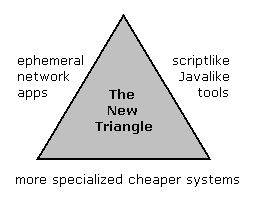
On the applications side, Microsoft has revealed that .NET
includes online services such as Passport, Hotmail, and
calendar services. It's not clear how Microsoft plans
to make money on these new software applications, but
certainly one path they could follow is the AOL
pay-as-you-go model. Certainly, Microsoft's services
do not have to be immortal in the same way as
their desktop software.
On the systems side, Microsoft is diversifying their
Windows platform to deal with the consequences of
the Moore's law inversion. They are releasing new
monolithic systems such as their Ultimate TV recorder
and their XBox game system, and they are rapidly
streamlining Windows CE to compete with Linux and
Palm. These new systems are not as configurable
by end users as Windows itself, but they are simpler,
more focused, and cheaper than a PC.
On the developer side, Microsoft is rallying support
around a new runtime system that helps developers
trade the Moore's law surplus to achieve lower software
development costs. They are introducing a Java-VM-like
Common Language Runtime that provides the same
developer conveniences as Java; they also contain
deep features that make it easy to build and integrate
with Microsoft's new generation of online applications,
and also take advantage of Microsoft's operating
systems.
On each of the three lines, Microsoft is facing a sea
change where they are starting on the losing side of
the battle. The old Windows franchise is ill-equipped
for the new challenges, and Microsoft has smart
competitors that have already started to entrench
themselves on high ground.
However, to Microsoft's advantage, they have a
uniquely unified strategy for all three battles,
and unlike their competitors, they can a execute
on a plan that advances all three lines
of their platform triangle while playing their
competitors against each other.
The question is no
longer if the industry is shifting. The question is,
when the dust settles, who will be left standing?

|